There’s a version of Athens that most visitors never see — not because it’s hidden, but because they arrive a month too late. Athens in May is that version: warm enough to sit outside with a coffee until midnight, cool enough to climb the Acropolis without feeling like you’re being slow-roasted, and quiet enough that you can actually stand in front of the Parthenon and think. June brings the crowds. July brings the heat. May is the city at its most livable, and if you time your trip right, you’ll spend a week wondering why anyone would choose to come any other time.
The Weather That Changes Everything
May temperatures in Athens typically sit between 18°C and 26°C (64–79°F), which sounds modest until you realize what it means in practice. You can walk from Monastiraki up to the Acropolis at noon and not arrive drenched. You can wander the marble lanes of Plaka for three hours before lunch without needing to duck into every air-conditioned shop. The evenings are genuinely pleasant — light jacket territory, not sweater weather, perfect for long dinners on a terrace.
This matters more than it sounds. Athens is a walking city, built on hills, paved in stone that reflects heat. In August, even locals minimize time outside between 1 and 5pm. In May, that constraint doesn’t exist. You get the full city, all day, at a human pace.
The rain is mostly gone by May, though you’ll occasionally get a brief afternoon shower — nothing that ruins a day. Skies are reliably blue, the light is extraordinary (golden hour in May lasts longer than you expect), and the air still carries that faint green freshness that disappears once the Attic summer sets in for real.
Ancient Athens, Without the August Crowds
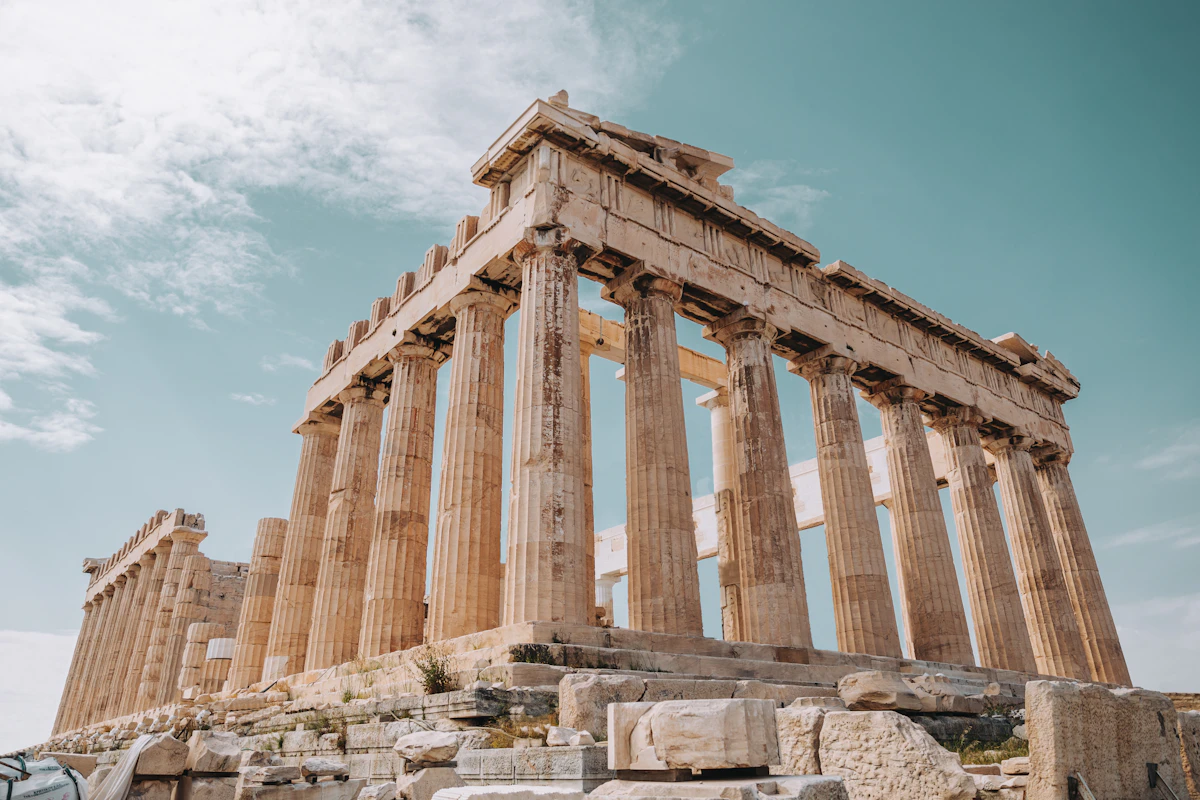
The Acropolis in May is a different experience than the Acropolis in July. The crowds haven’t peaked yet, especially if you go early — gates open at 8am, and the first hour before tour groups arrive is genuinely serene. You’ll still share the site with other visitors, but you won’t be shuffling forward in a slow queue just to reach the Propylaea.
The same logic applies to the Agora, the Temple of Olympian Zeus, and the National Archaeological Museum. Lines are shorter. Guards aren’t overwhelmed. You can linger.
One of the quieter rewards of a May visit is Philopappos Hill, just southwest of the Acropolis. By late April and into May, the hillside is covered in wildflowers — red poppies, yellow daisies, wild herbs — against the limestone and pine. It’s one of those scenes that doesn’t photograph as well as it looks in person, which is somehow more satisfying. The view back toward the Parthenon from the Philopappos Monument is the one the postcards don’t use, and in May, you’ll often have it nearly to yourself.
For practical guidance on making the most of the walk between neighborhoods and monuments, the walking to the Acropolis guide covers the routes from Plaka and Monastiraki in detail — both are genuinely walkable, and May is the ideal month to do it.
Orthodox Easter and the Celebrations That Follow
Greece runs on the Orthodox calendar, and Easter — Pascha — typically falls in late April or May (in 2025, it lands on April 20th; in 2026, it’s May 3rd). If your trip overlaps with Orthodox Easter week, you’re in for something extraordinary. The Epitaphios procession on Good Friday, where churches carry flower-covered biers through the streets at night, is one of the most quietly moving things you can witness in Athens.
The Saturday midnight Resurrection service, where thousands of people light candles from a single flame and the city briefly goes dark before erupting in bells and fireworks — that’s not a tourist event. It happens in every neighborhood, at every church, and you’re welcome to stand outside and watch. The week after Easter, called Bright Week, sees restaurants and kafeneions full of families, lamb on the spit, red-dyed eggs cracked against each other at the table. The city is in a good mood.
Even if your dates don’t align with Easter itself, May carries that post-celebration warmth. Outdoor seating fills up. People stay out later. The energy is relaxed in a way that feels earned.
The Athens Epidaurus Festival: Early Season Previews
The Athens Epidaurus Festival — one of Europe’s oldest and most celebrated summer arts festivals — officially runs from June through August, with performances at the ancient Odeon of Herodes Atticus on the south slope of the Acropolis and at the Theatre of Epidaurus in the Peloponnese. But May is when the season quietly begins.
Keep an eye on the festival’s official calendar closer to your dates, because select early performances and preview events do appear in May, particularly at the Odeon. Seeing a concert or theatrical performance at Herodes Atticus — an open-air Roman theater built in 161 AD, with the Acropolis lit up directly above the stage — is one of those Athens experiences that’s hard to overstate. The acoustics are extraordinary, the setting is unlike anything else in the world, and a May performance means you’re watching with a fraction of the summer crowd.
Why Where You Stay Matters More in May
All of this — the wildflower walks, the early morning Acropolis, the late dinners, the Orthodox processions — is best experienced from a base in the historic center. Staying in Plaka or Monastiraki means you’re ten minutes on foot from nearly every ancient site, and in May’s perfect walking weather, that proximity becomes the structure of your whole day.
The team at Athenian Ascents runs boutique apartments across Plaka, Monastiraki, and Psyrri — all within that walkable radius. Properties like Acropoli’s Balcony and AcroView Right In The Center are specifically positioned so you can step outside and be in the thick of it within minutes, not a metro ride away.
For neighborhood context before you book, the 3-day Athens itinerary is worth reading — it’s structured around exactly the kind of unhurried, walkable pace that May rewards.
May is the month Athens gives you everything and asks very little in return. The light is right, the temperature is forgiving, the city is still itself. Come before summer makes it something slightly different.
Book Your Athens Stay Direct — Save 10%
All properties in this guide are managed by Athenian Ascents — boutique apartments in Plaka, Monastiraki, and Psyrri.
📍 Browse all apartments → 💰 Book direct and save 10% vs Airbnb or Booking.com 🏛️ Steps from the Acropolis · Free cancellation available